Scorpions Deliberately Fortify Their Pincers and Stingers with Metals
A groundbreaking study reveals that scorpions actively reinforce their natural weapons—the front pincers (chelae) and venomous tail stinger (telson)—with metals like zinc, manganese, and iron. This intentional process, rather than accidental environmental uptake, represents a remarkable example of biological engineering.
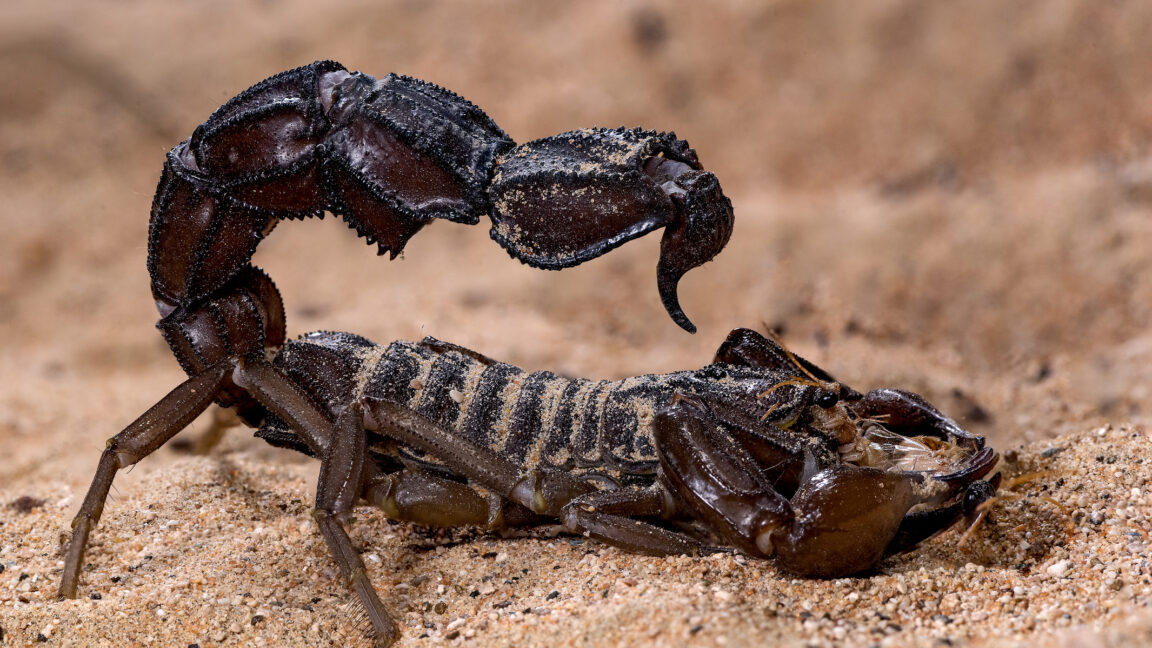
The research, published in the Journal of The Royal Society Interface, analyzed the distribution of metals across multiple scorpion species. Lead author Sam Campbell, a biologist at the University of Queensland, Australia, said the findings settle a long-standing question.
“That the metals are there has been known since the 1990s. What we didn’t know was whether scorpions evolved to be like that or if it was accidental and they were just picking the metals up from the environment.”
Background: A Decades-Old Puzzle
For over 30 years, scientists have detected heavy metals in scorpion exoskeletons. However, the mechanism behind this accumulation remained unclear—was it passive absorption from soil or prey, or an active evolutionary adaptation?
Campbell and his team conducted a detailed chemical analysis of the stingers and pincers from various species. Their data shows a non-random, species-specific distribution of metals, strongly suggesting deliberate placement.
Chemical Analysis Confirms Intentional Reinforcement
Using advanced spectroscopy techniques, the team mapped metal concentrations at microscopic levels. The results show elevated zinc levels in the stinger tip and increased manganese and iron in the pincer edges—precisely where mechanical stress is highest.
“The patterns are too consistent to be accidental. Scorpions are actively controlling metal deposition to harden specific parts of their body,” Campbell explained.
What This Means: Evolution and Bio-Inspired Materials
This discovery reshapes our understanding of arthropod evolution. Scorpions have developed a sophisticated biological pathway to extract, transport, and deposit metals, likely to enhance the durability and penetrating power of their weapons.
The implications extend beyond biology. Materials scientists are now studying scorpion exoskeletons as a model for creating lightweight, corrosion-resistant composites. “Nature has already solved the problem of making hard, tough materials without high temperatures or toxic chemicals,” said Campbell.
Key Takeaways
- Active bioengineering: Scorpions selectively incorporate metals into specific body parts.
- Evolutionary advantage: Reinforced weapons improve hunting and defense efficiency.
- Technological inspiration: Could lead to new metal-polymer hybrids for industrial use.
The study is published in the Journal of The Royal Society Interface. Further research will explore the genetic and biochemical mechanisms behind this metal-working ability.