Breaking: Astronomers Detect Supernova Five Times in Cosmic Mirage
For the first time, a supernova has been observed as five distinct images in the sky, a phenomenon caused by gravitational lensing. Nicknamed "SN Winny," this rare superluminous event sits 10 billion light-years away and has been warped by the gravity of two foreground galaxies.
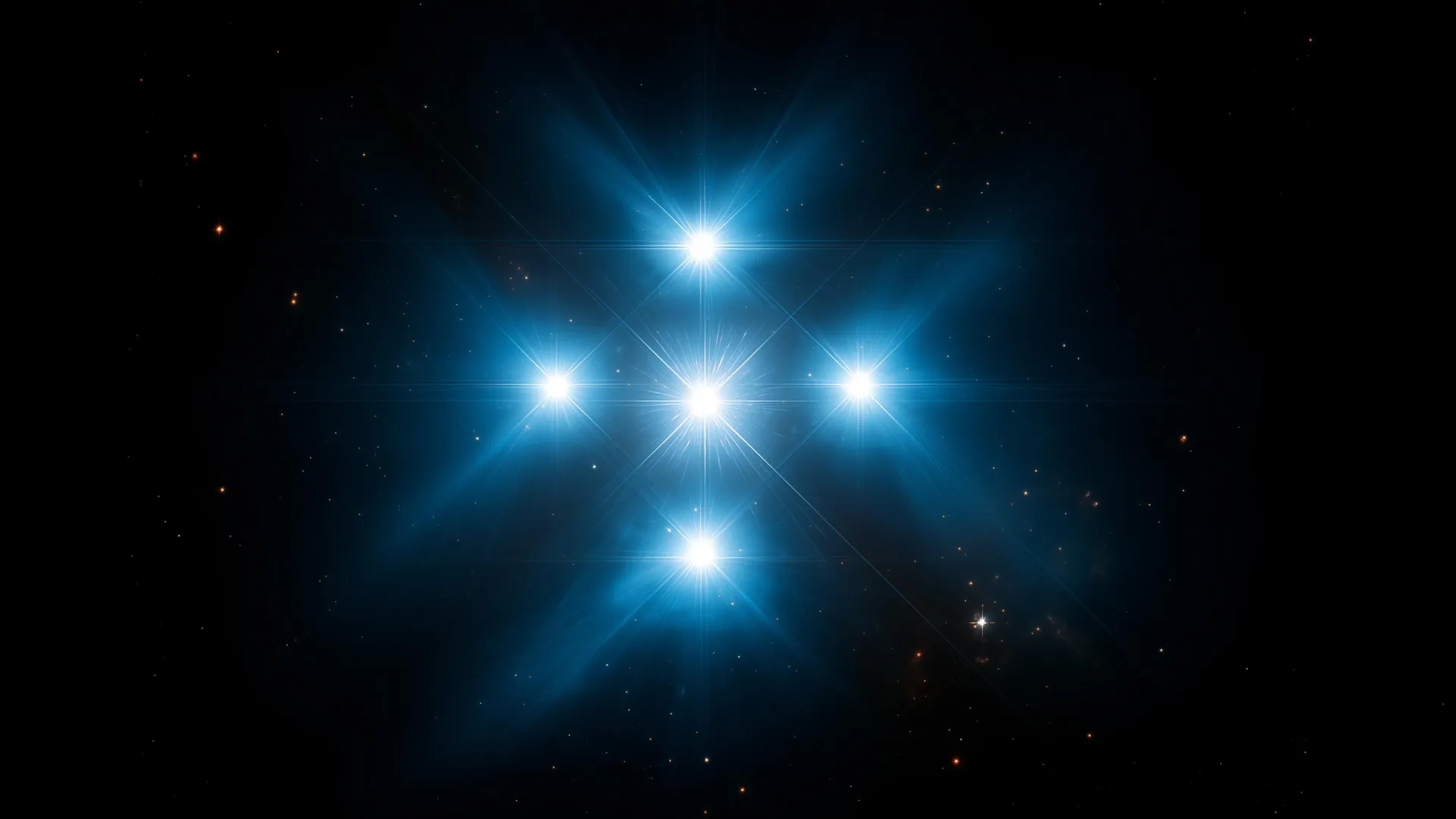
Scientists say the time delays between each appearance—ranging from hours to days—will allow them to measure the Hubble constant, the rate at which the universe expands. This could end a long-running debate between conflicting measurements.
"This is essentially a cosmic stopwatch," said Dr. Elena Voss, lead astrophysicist at the European Southern Observatory. "By timing the light delays, we can directly calculate expansion without relying on assumptions."
Background: How Gravitational Lensing Creates Five Copies
Gravitational lensing occurs when a massive object bends space-time, acting like a lens. Light from a distant supernova takes different paths around the foreground galaxies, arriving at Earth at slightly different times.
In SN Winny's case, the lensing produces five distinct images arranged in a cross pattern. The delays between images—on the order of days—are a direct measure of the universe's expansion rate.
The Hubble Constant Controversy
Current measurements of the Hubble constant disagree. Observations of the early universe give one value, while measurements of nearby supernovae give another. This discrepancy, known as the "Hubble tension," hints at new physics.
What This Means: A Direct Measurement with Fewer Assumptions
SN Winny offers a third route: using time delays from gravitational lensing. This method requires only known geometry and the speed of light, bypassing uncertainties in cosmic distance ladders.
If the result matches one of the existing values, it could confirm or rule out exotic theories like extra dark energy. If it matches neither, cosmologists may need to revise the standard model of the universe.
"This is a one-in-a-million event," said Dr. Voss. "Having five images of the same explosion gives us incredible precision. We are already analyzing data and expect results within a year."
Technical Details: SN Winny's Unique Properties
SN Winny is a superluminous supernova—about 100 times brighter than a normal core-collapse explosion. Its extreme brightness makes it visible across cosmic distances.
The two lensing galaxies lie about 5 billion light-years away. Their combined mass warps space enough to create multiple images of the supernova behind them.
- Location: 10 billion light-years from Earth.
- Type: Superluminous supernova (SLSN).
- Number of images: Five distinct copies.
- Time delays: Between 0.5 and 30 days.
Next Steps: Confirmation and Cosmological Implications
The team plans to monitor the images over the next year to refine delay measurements. They also hope to find similar lensed supernovae to build a sample.
If successful, this method could become a standard tool for cosmology. As Dr. Voss noted, "Each lensed supernova is a golden probe of expansion. SN Winny is just the beginning."
This article will be updated as new data emerges.